About the OOF® Authority Governance Reference
CANONICAL · CURRENT
Authority Governance Reference Views
View 1 remains the original Core Reference View. These final View 2 and View 3 diagrams supersede only their earlier visual iterations.
OOF® — OriginOpen® Foundation
Artifact Type: OOF® Governance Reference
Reference Name: Authority Governance Reference
Descriptor: A Governance Reference for Authority Across Human, Organizational, and Intelligent Systems
Scope: Humans · Organizations · AI Systems · Agentic Systems · Autonomous Systems · Robotics
Status: Published Methodological Reference
Authority: OOF® — OriginOpen® Foundation
Canonical Language: English
Website: https://originopenfoundation.org/
1. Canonical Definition
The OOF® Authority Governance Reference establishes a common, technology-independent methodological reference for determining how authority is legitimately established, held, scoped, delegated, maintained, exercised, evidenced, attributed, reassessed, restricted, suspended, revoked, or newly established across human, organizational, and intelligent systems.
It defines the governance conditions under which authority must remain legitimate, bounded, current, and traceable throughout its applicable lifecycle.
The Reference does not create legal authority, grant operational permissions, or replace applicable laws, institutional mandates, organizational governance structures, or technical authorization mechanisms.
It provides a common methodological basis against which authority-governance arrangements can be designed, examined, compared, and improved.
2. What It Is
The Authority Governance Reference is a system-level governance reference for authority itself.
It addresses five fundamental questions:
- Where does legitimate authority come from?
- Who or what legitimately holds that authority?
- What actions, purposes, resources, conditions, and boundaries does it cover?
- Under what conditions may authority be delegated, exercised, changed, or revoked?
- How can the exercise of authority and its consequences remain evidenced, attributable, and accountable?
The Reference connects these questions into one coherent governance lifecycle rather than treating authority establishment, delegation, authorization, execution, revocation, and accountability as unrelated mechanisms.
3. What It Is Not
The Authority Governance Reference is not a legal code, government regulator, certification authority, identity provider, access-control protocol, or technical permission engine.
It does not claim that all actors possess identical legal capacities, rights, responsibilities, or forms of agency.
It does not establish that an AI system or autonomous machine possesses independent legal authority merely because it can execute an action.
It does not replace identity and access management, contractual authority, organizational approvals, or legally established accountability arrangements.
It governs the methodological relationship among these mechanisms without assuming that any single mechanism is sufficient to establish legitimate authority.
4. Why It Is Important
Authority increasingly operates across interconnected environments.
A human may authorize an organization, an organization may appoint a representative, a representative may delegate a task to an AI agent, and an agent may coordinate tools, downstream systems, or robotic execution.
Each transition introduces the possibility of authority becoming unclear, exceeded, outdated, improperly delegated, technically accessible without legitimate permission, or impossible to reconstruct.
A technically successful action does not establish that the actor possessed legitimate authority to perform it.
Similarly, a valid credential, an orchestration decision, or a historical authorization does not independently establish current authority.
The Reference provides a common governance structure for examining these distinctions before, during, and after governed action.
5. One Governance Logic Across Different Actors
Authority should not require a different governance logic merely because the actor changes from human to organization to machine.
This is a foundational positioning principle of the OOF® Authority Governance Reference.
Humans, organizations, AI systems, agentic systems, autonomous systems, and robotics may operate under different legal, technical, organizational, and operational conditions.
Their authority sources, capacities, limitations, and accountability arrangements may differ substantially.
Nevertheless, the underlying governance questions remain applicable:
- Is there a legitimate authority basis?
- Is the authority holder identifiable?
- Is the authority appropriately bounded?
- Is delegation permitted and controlled?
- Does the authority remain valid when exercised?
- Can the action and its consequences be evidenced and attributed?
- Can authority be reassessed and corrected when necessary?
The Reference establishes a common governance logic while allowing actor-specific implementation requirements.
The actor may change. The requirement for legitimate, bounded, current, and traceable authority does not.
This is a methodological unification principle, not a claim that humans and machines are legally or institutionally equivalent.
6. Position in Architecture Governance Flow
The Authority Governance Reference operates as a cross-architecture methodological reference within the OOF® governance infrastructure.
It may inform authority-related mechanisms within governance architectures concerned with identity, delegation, autonomous execution, operational reality, evidence, accountability, liability, and related domains.
It does not replace the independent governed domains of those architectures.
Instead, it establishes common authority-governance distinctions that can be referenced consistently wherever authority is established, transferred, exercised, challenged, or withdrawn.
The Reference remains methodologically independent of any particular software engine, organizational structure, implementation technology, or actor category.
7. Authority Governance Lifecycle
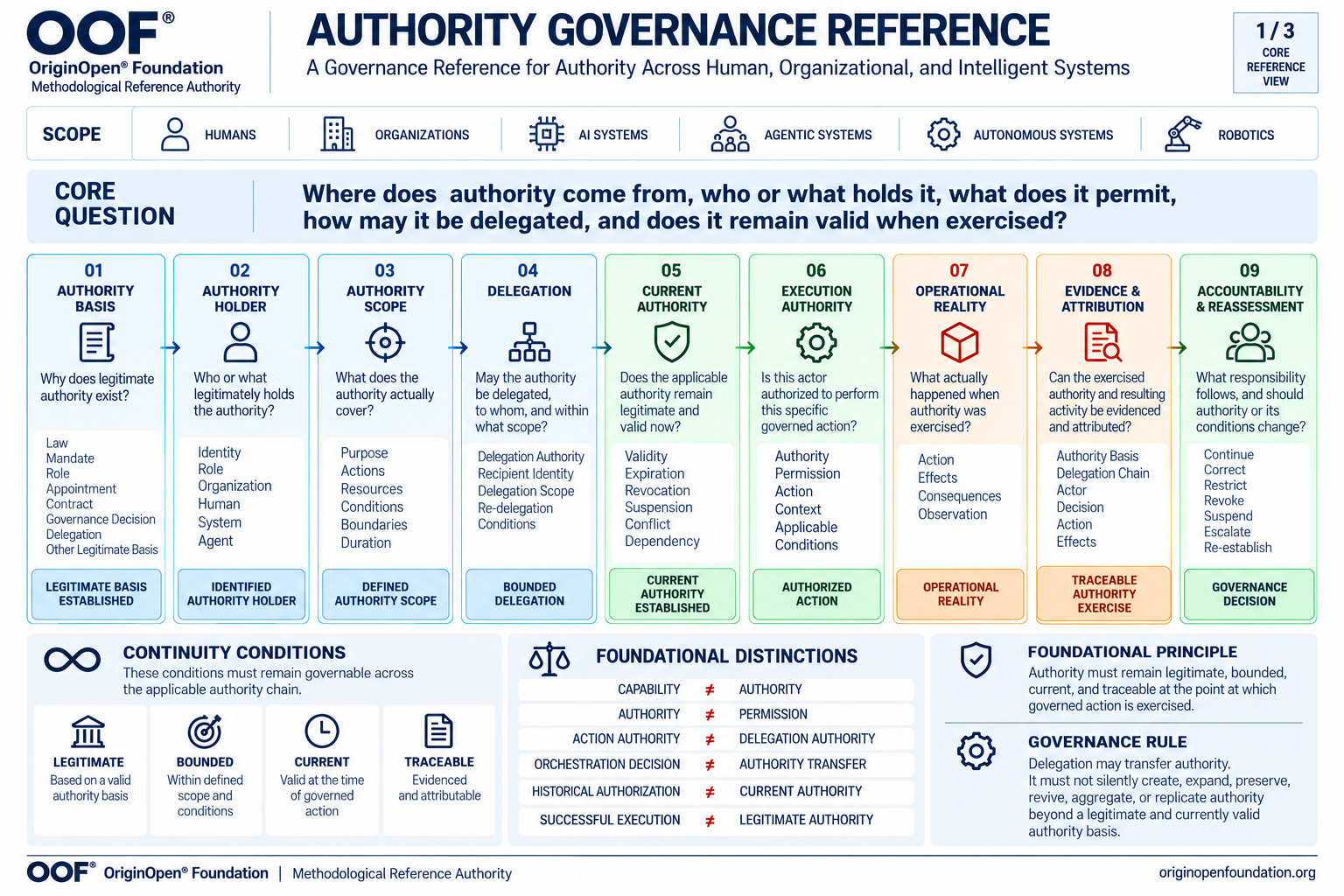
The Core Reference View establishes the principal governance flow:
Authority Basis → Authority Holder → Authority Scope → Delegation → Current Authority → Execution Authority → Operational Reality → Evidence & Attribution → Accountability & Reassessment
Authority may arise through law, mandate, role, appointment, contract, governance decision, delegation, or another legitimate basis.
Delegation is therefore one possible authority mechanism, not the universal origin of authority.
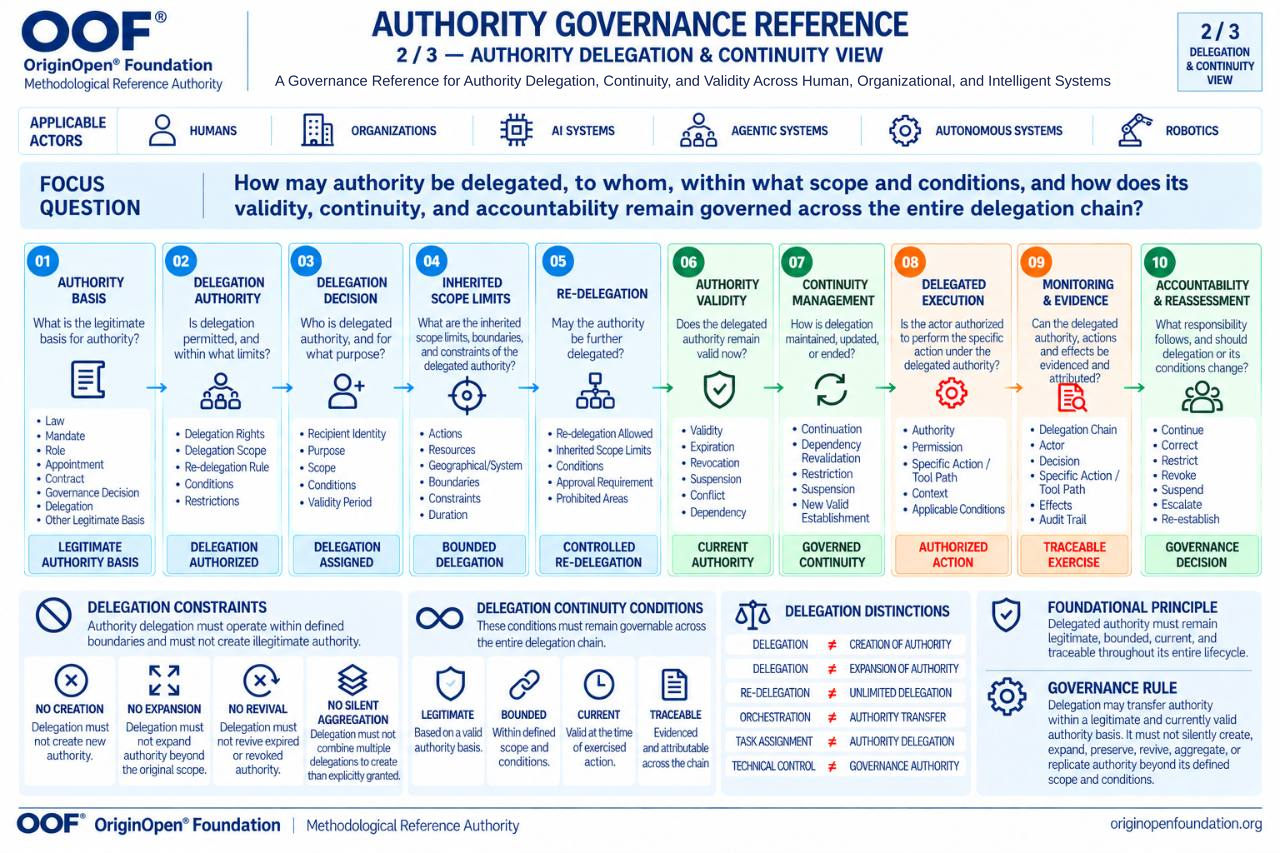
Where delegation occurs, additional controls are required to govern its legitimacy, scope, recipients, re-delegation, validity, continuity, and traceability.
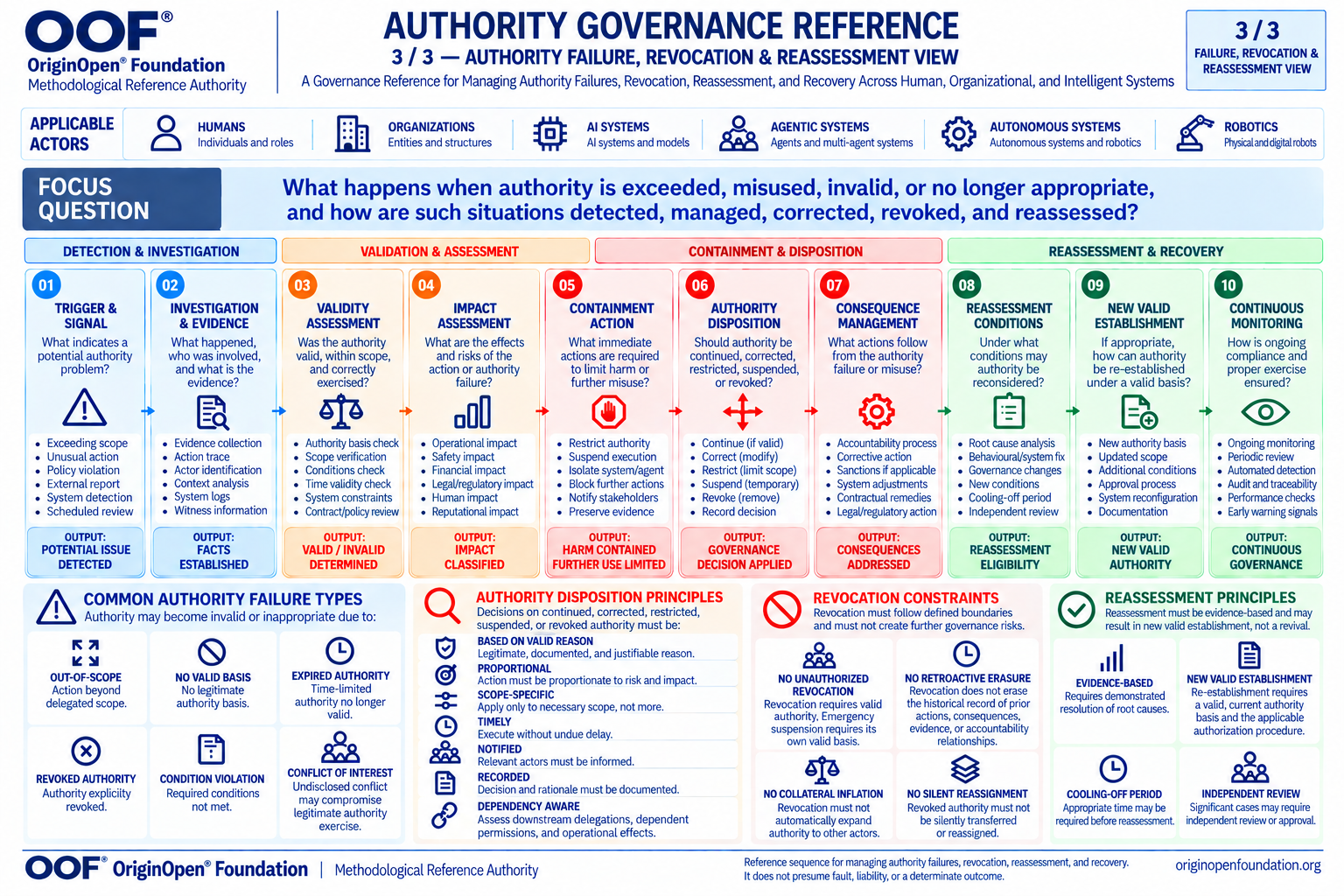
Where authority fails or becomes inappropriate, governance must provide mechanisms for detection, investigation, containment, disposition, consequence management, and reassessment.
These processes are interconnected, but not every authority arrangement requires delegation, and not every authority failure requires revocation.
8. The Three Reference Views
View 1 — Core Reference View
Establishes the general authority-governance lifecycle from legitimate basis to accountability and reassessment.
View 2 — Authority Delegation & Continuity View
Examines the controlled transfer and continuity of authority across actors, systems, organizational boundaries, and delegation chains.
It establishes that delegation must not silently create, expand, revive, aggregate, or replicate authority beyond a legitimate and currently valid basis.
View 3 — Authority Failure, Revocation & Reassessment View
Examines how authority problems are detected, investigated, contained, assessed, corrected, restricted, suspended, revoked, or reconsidered.
It distinguishes authority disposition from automatic revocation and new valid establishment from the unauthorized revival of expired or revoked authority.
Together, the three views provide a unified methodological reference covering authority establishment, continuity, exercise, failure, and reassessment.
9. Foundational Governance Distinctions
The Reference preserves the following distinctions:
- Capability ≠ Authority
- Authority ≠ Permission
- Action Authority ≠ Delegation Authority
- Orchestration Decision ≠ Authority Transfer
- Task Assignment ≠ Authority Delegation
- Historical Authorization ≠ Current Authority
- Technical Control ≠ Governance Authority
- Successful Execution ≠ Legitimate Authority
- Revocation ≠ Retroactive Erasure
These distinctions prevent technical capability, operational success, or historical authorization from being incorrectly treated as sufficient evidence of legitimate authority.
10. Practical Applications
The Reference may be used to support:
- Organizational mandates, appointments, approvals, and delegated responsibilities.
- Corporate authority chains and cross-organizational delegation.
- AI-agent task assignment, tool execution, and multi-agent delegation.
- Autonomous system execution boundaries and human intervention arrangements.
- Robotic operations involving delegated operational authority.
- Authority revocation, suspension, and reassessment procedures.
- Evidence collection, authority-chain reconstruction, and accountability analysis.
- Governance gap identification and authority-control improvement.
Its purpose is not to prescribe one universal technical implementation.
Its purpose is to make the relevant governance conditions identifiable, testable, and explainable across different implementations.
11. Governance Outputs
Application of the Reference may produce:
- Authority Basis Record — identification of the applicable legitimate authority basis.
- Authority Scope Definition — documented purposes, actions, resources, conditions, and boundaries.
- Delegation Chain Record — traceable authority transfers and applicable restrictions.
- Current Authority Assessment — evidence of validity at the relevant point of action.
- Execution Authority Assessment — determination of whether a specific actor may perform a specific governed action.
- Authority Exercise Evidence — reconstruction of decisions, actions, effects, and attribution.
- Authority Disposition Record — documented continuation, correction, restriction, suspension, or revocation decisions.
- Reassessment Record — evidence supporting subsequent governance decisions or new valid establishment.
These are reference-level output categories, not claims that a particular organization already implements them.
12. Methodological Stability, Validation & Evolution
The OOF® Authority Governance Reference is intended to provide a stable and reliable methodological foundation.
Stability does not mean immutability.
The Reference may evolve when credible evidence identifies a methodological defect, unresolved governance gap, contradiction, newly observed authority failure, or material change in the governed reality.
Such findings may originate from OOF® research, adversarial stress testing, implementation experience, independent expert review, incident analysis, or other verifiable evidence.
However, a proposed change must not be accepted merely because it is commercially convenient, technically easier to implement, or preferred by an individual organization.
Every material methodological change should follow a controlled governance process:
Finding → Evidence → Gap Validation → Impact Assessment → Proposed Correction → Consistency Testing → Approval → Versioned Publication
This process must distinguish between:
- A defect in the Reference itself.
- A failure of an organization to implement the Reference correctly.
- An actor-specific requirement that does not justify changing the common governance logic.
- A genuinely new governance condition requiring an extension or revision.
Material revisions should identify the affected definitions, principles, boundaries, lifecycle stages, and related reference views.
Where appropriate, revisions should preserve historical versions, provide a change rationale, and explain compatibility implications.
Previous versions must not be silently rewritten to conceal methodological corrections.
A validated governance gap is a reason to examine the methodology, not an automatic reason to abandon its foundational principles.
The objective is controlled methodological improvement while preserving conceptual integrity and long-term reference continuity.
13. Governance Authority & Adoption
OOF® maintains methodological authorship and governance responsibility for the Authority Governance Reference.
Organizations may use the Reference to design, assess, or align their authority-governance arrangements, subject to applicable rights and conditions of use.
Adoption does not automatically constitute OOF® certification, regulatory approval, legal compliance, or verified implementation conformity.
Independent review, implementation testing, and external criticism may strengthen the Reference by exposing weaknesses and providing additional evidence.
Such review does not transfer methodological ownership or automatically override the Reference's established governance process.
The Reference must remain open to justified correction while protected against arbitrary, undocumented, or commercially driven changes.
14. Core Governance Principles
Legitimate Authority Principle
Authority must rest on an applicable legitimate basis.
Bounded Authority Principle
Authority must remain within its established purpose, scope, conditions, and limitations.
Current Authority Principle
Authority must be valid at the relevant point of governed action.
Delegation Integrity Principle
Delegation must not silently create or expand authority beyond a legitimate basis.
Authority Traceability Principle
The applicable authority chain and its exercise must remain reconstructable to the extent required by the governed context.
Accountability Continuity Principle
Changes to authority do not automatically erase prior actions, evidence, consequences, or accountability.
Methodological Evolution Principle
The Reference may be corrected or extended when justified by validated governance evidence through controlled versioned revision.
15. Canonical Closing Statement
Authority governance must remain coherent when authority moves between people, organizations, intelligent systems, and operational environments.
Different actors may require different implementations, but the fundamental requirement remains the same: authority must be legitimate, bounded, current, traceable, and subject to accountable governance.
The OOF® Authority Governance Reference establishes a common methodological foundation for examining those requirements throughout the authority lifecycle.
Its principles are intended to remain stable, its applications adaptable, and its methodology open to evidence-based correction where genuine governance gaps are demonstrated.
The actor may change. The requirement for legitimate, bounded, current, and traceable authority does not.
OOF® — OriginOpen® Foundation
Methodological Reference Authority