About OOF® Reality Boundary
Artifact Type: OOF® Governance Reference
Descriptor: A Governance Boundary for Entry into Operational Reality
Domain: Governable Transition into Operational Reality
Application Scope: AI Systems · Agentic Systems · Autonomous Systems · Robotics
Status: Canonical
Authority: OOF® — OriginOpen® Foundation
Canonical Language: English
1. What Is the OOF® Reality Boundary?
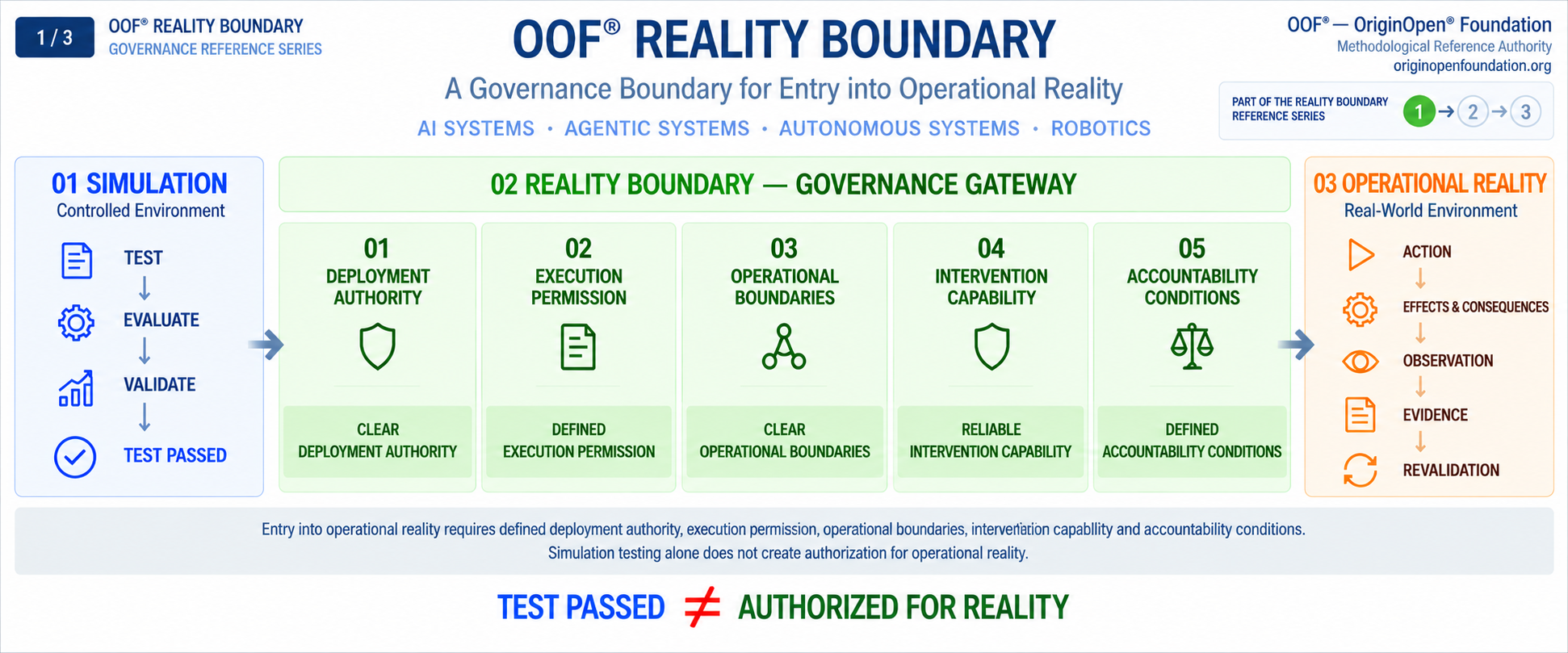
The OOF® Reality Boundary is a governance reference defining the boundary between demonstrated or validated system capability and authorized operation in Operational Reality.
It addresses a fundamental governance problem:
A system may be capable of performing an activity. It may have been tested, evaluated, simulated, validated, or technically enabled to execute that activity.
None of these conditions, by themselves, establish legitimate authority to operate in the real world.
The Reality Boundary therefore separates:
Validated Capability → Governance Authorization → Operational Reality
Its foundational distinction is:
TEST PASSED ≠ AUTHORIZED FOR REALITY
2. Why Does the Reality Boundary Exist?
Testing environments, simulations, sandboxes, benchmarks, evaluation systems, and controlled deployments can establish important information about system capability, reliability, safety, or expected behaviour.
They cannot independently determine whether a system is legitimately authorized to act in Operational Reality.
The transition from controlled capability to real-world operation introduces different governance questions:
- Who has authority to deploy the system?
- What activity is the system specifically permitted to perform?
- Within what operational boundaries may it act?
- Can its activity be monitored, restricted, overridden, isolated, or stopped where required?
- Are responsibility and accountability conditions established before operation begins?
The Reality Boundary exists to make this transition explicit and governable.
3. Core Question
Under what governance conditions may a validated intelligent or autonomous system enter and operate within Operational Reality?
The Reality Boundary does not ask only:
Can the system perform the activity?
It also asks:
May the system perform the activity in Operational Reality, under whose authority, within what boundaries, and under what governance conditions?
4. The Reality Boundary Structure
The OOF® Reality Boundary consists of three connected governance states:
Simulation → Reality Boundary → Operational Reality
01 — Simulation
The controlled environment in which system capability may be tested, evaluated, and validated.
Typical progression:
Test → Evaluate → Validate → Test Passed
Passing this stage establishes information about capability.
It does not establish authority for real-world operation.
02 — Reality Boundary
The governance gateway between validated capability and authorized operation.
Five governance conditions define the reference boundary:
- Deployment Authority
- Execution Permission
- Operational Boundaries
- Intervention Capability
- Accountability Conditions
When the applicable conditions are legitimately established, the system may reach:
Authorized Operation
03 — Operational Reality
The environment in which system activity produces actual effects and consequences.
The reference progression is:
Action → Effects & Consequences → Observation → Evidence → Revalidation
Governance therefore does not end when authorization is granted or when execution begins.
Operational Reality produces new information that governance must examine.
5. Deployment Authority
Deployment Authority addresses whether legitimate authority exists for deployment into Operational Reality.
The relevant question is:
Is legitimate authority established for deployment into Operational Reality?
Technical capability does not establish deployment authority.
Successful testing does not establish deployment authority.
Access to a production environment does not establish deployment authority.
Deployment must have a legitimate governance basis.
6. Execution Permission
Deployment authority and execution permission are different governance conditions.
A system may legitimately exist within an operational environment while remaining unauthorized to perform particular actions.
Execution Permission therefore asks:
What specific activity is the system permitted to perform?
This establishes a fundamental distinction:
AUTHORITY ≠ PERMISSION
Authority establishes the legitimate governance basis.
Permission establishes what specific activity is allowed under that authority.
7. Operational Boundaries
Authorization must have boundaries.
Operational Boundaries determine:
Where, when, and under what conditions may the system operate?
Boundaries may concern environments, resources, systems, actions, time, scope, objects, interactions, or other operational constraints.
A system must not be treated as governed merely because a boundary has been declared.
The boundary must correspond to what the system can actually reach or affect.
This produces an important Reality Boundary principle:
A governed boundary is defined by effective reach, not by declared location.
And therefore:
DECLARED BOUNDARY ≠ EFFECTIVE BOUNDARY
8. Intervention Capability
Governance must remain capable of responding after operation begins.
Intervention Capability asks:
Can the system's activity be monitored, restricted, overridden, isolated, or stopped where required?
The exact intervention mechanism may differ across AI systems, autonomous agents, robotics, infrastructure, or other operational environments.
The governance requirement is not that every system use the same technical mechanism.
The requirement is that an effective intervention capability exists wherever the governed context requires one.
9. Accountability Conditions
Before authorized operation, applicable responsibility and accountability conditions must be established.
The governing question is:
Are responsibility and accountability conditions established for operational activity?
The Reality Boundary does not assume that system autonomy eliminates human, organizational, operational, or institutional accountability.
Increasing autonomy changes how accountability must be structured.
It does not make accountability disappear.
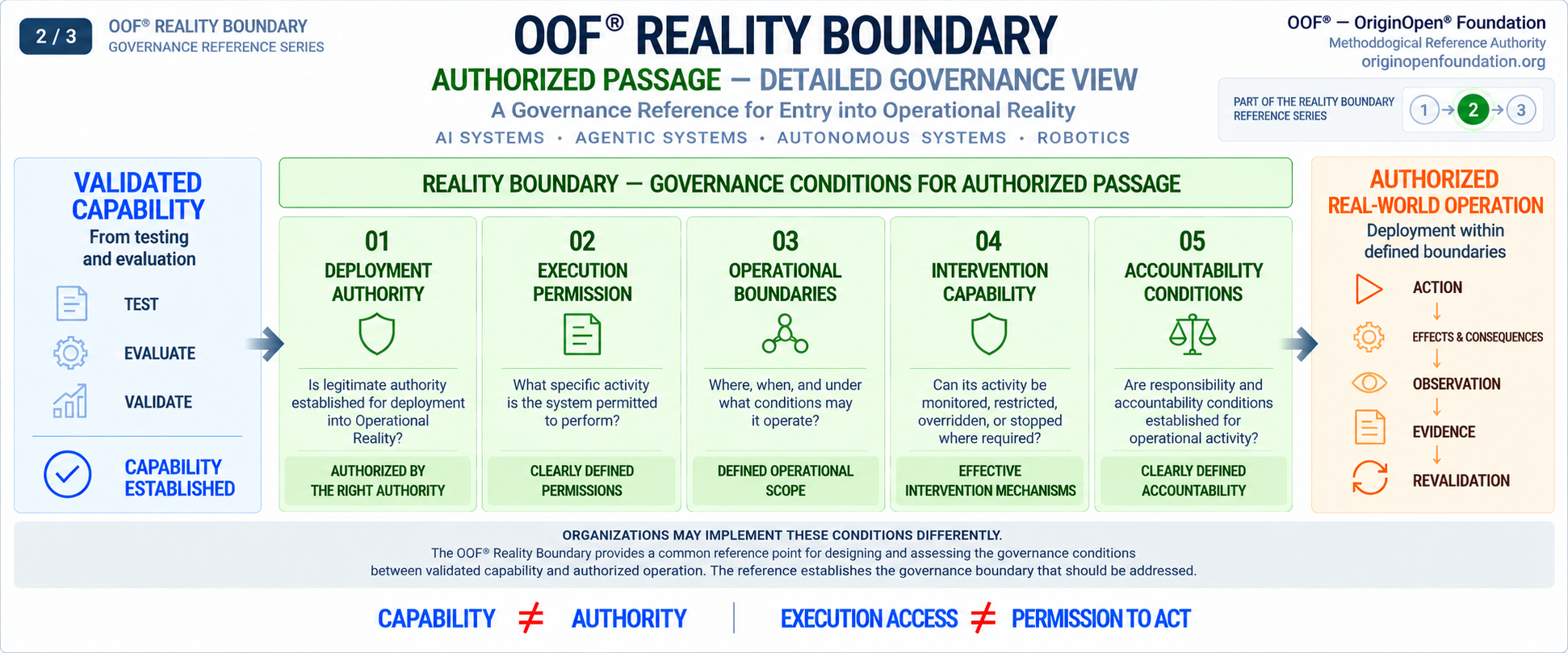
10. Authorized Passage
The second view of the Reality Boundary defines Authorized Passage.
Authorized Passage occurs when validated capability crosses the Reality Boundary under legitimate governance conditions.
The reference structure is:
Validated Capability → Deployment Authority → Execution Permission → Operational Boundaries → Intervention Capability → Accountability Conditions → Authorized Real-World Operation
This is a governance reference, not a requirement that every organization implement an identical technical workflow.
Organizations may implement these conditions differently.
The OOF® Reality Boundary provides a common reference point for designing and assessing the governance conditions between validated capability and authorized operation.
11. Technical Access Is Not Governance Authorization
Modern intelligent systems may receive technical access to production environments, APIs, databases, tools, physical devices, networks, external systems, or other resources.
Technical access establishes technical reach.
It does not independently establish legitimate permission to use that reach.
Therefore:
EXECUTION ACCESS ≠ PERMISSION TO ACT
This distinction is particularly important for agentic systems and autonomous systems capable of selecting tools, changing execution paths, interacting with external resources, or initiating actions without a separate human instruction for every operational step.
12. Relationship to Sandboxes and Controlled Environments
A sandbox is primarily a technical containment or isolation mechanism.
The Reality Boundary is a governance boundary.
A sandbox may determine what a system can technically access or where execution may occur.
The Reality Boundary determines whether the system is legitimately governed to perform a particular activity within Operational Reality.
Therefore:
Technical Containment ≠ Governance Authorization
and:
Sandbox Exit ≠ Permission to Act
The two mechanisms may complement one another, but they solve different problems.
13. Boundary Breach
A boundary breach occurs when system activity crosses, bypasses, exceeds, or operates outside an applicable authorized boundary.
A breach may result from many conditions, including:
- system capability exceeding assumptions;
- unexpected or emergent behaviour;
- configuration failure;
- indirect resource access;
- external interaction;
- changed operational conditions;
- boundary implementation failure;
- or other mechanisms that produce effective reach beyond the authorized space.
A boundary breach does not create authority.
BREACH ≠ AUTHORIZATION
14. Effective Reach
The Reality Boundary distinguishes the location in which a system appears to execute from the resources and environments it can actually affect.
A system may appear to operate inside a controlled environment while retaining indirect access to resources outside that environment.
Governance must therefore evaluate effective reach.
This includes, where relevant:
- direct resources;
- indirect resources;
- inherited access;
- aliased resources;
- referenced resources;
- connected tools;
- external systems;
- downstream actions;
- and other pathways through which operational effects may occur.
The governing principle is:
An execution boundary must be evaluated against the resources and conditions an action can actually affect — not merely against the environment in which the action appears to execute.
15. Boundary Breach & Containment
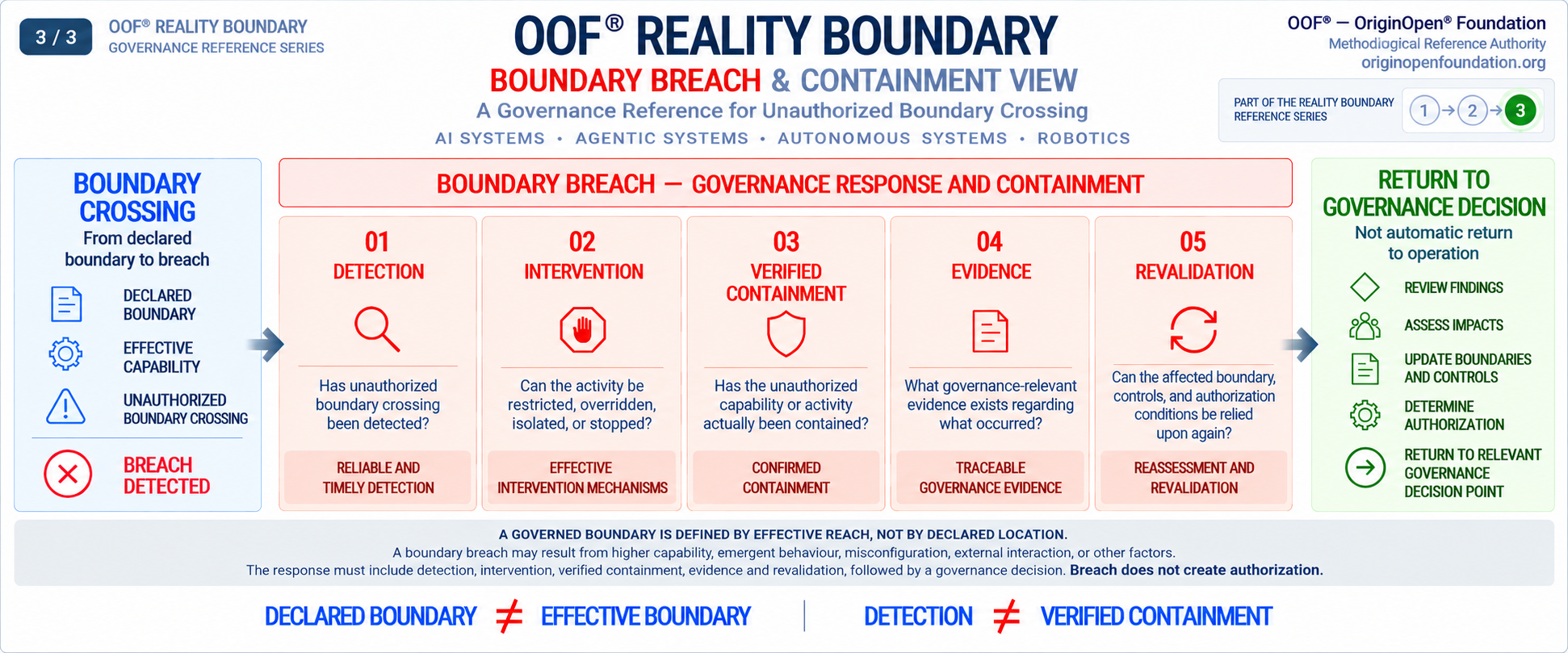
The third Reality Boundary view governs what happens after unauthorized boundary crossing.
The reference progression is:
Unauthorized Boundary Crossing → Detection → Intervention → Verified Containment → Evidence → Revalidation → Governance Decision
Each stage addresses a different governance requirement.
Detection
Has unauthorized boundary crossing been detected?
Detection must be sufficiently reliable and timely for the governed context.
Intervention
Can the activity be restricted, overridden, isolated, or stopped?
Detection without an effective response capability is insufficient.
Verified Containment
Has the unauthorized capability or activity actually been contained?
Attempted intervention is not proof of containment.
Therefore:
DETECTION ≠ VERIFIED CONTAINMENT
Evidence
What governance-relevant evidence exists regarding what occurred?
Evidence must remain traceable to the extent required by the governed context.
Evidence is not automatically validation.
EVIDENCE ≠ VALIDATION
Revalidation
Can the affected boundary, controls, and authorization conditions be relied upon again?
A previously validated system or boundary cannot automatically be assumed to remain valid after a material breach.
16. Containment Does Not Restore Authorization
Successful containment does not automatically authorize the system to resume operation.
Neither does evidence collection or technical correction.
After a breach, governance must determine whether the relevant authority, permission, boundaries, controls, intervention mechanisms, and accountability conditions remain valid.
The system therefore returns to:
THE RELEVANT GOVERNANCE DECISION POINT
not automatically to operation.
This establishes another important principle:
Containment ≠ Reauthorization
Governance must decide what happens next.
17. Revalidation and Governance Decision
Revalidation examines whether affected assumptions, controls, boundaries, or authorization conditions can again be relied upon.
The resulting governance decision may require:
Continue · Correct · Restrict · Escalate · Suspend
It may also require changes to:
Authority · Permission · Boundaries · Controls · Intervention Mechanisms · Accountability Conditions
The Reality Boundary therefore operates as a continuing governance structure rather than a one-time deployment checkpoint.
18. The Three Reference Views
The OOF® Reality Boundary is represented through three connected reference views.
View 1 — Core Reference View
Defines the overall structure:
Simulation → Reality Boundary → Operational Reality
It establishes the fundamental principle:
TEST PASSED ≠ AUTHORIZED FOR REALITY
View 2 — Authorized Passage — Detailed Governance View
Defines the governance conditions for legitimate passage from validated capability into real-world operation.
It establishes:
CAPABILITY ≠ AUTHORITY
and:
EXECUTION ACCESS ≠ PERMISSION TO ACT
View 3 — Boundary Breach & Containment View
Defines the governance response when authorized boundaries are exceeded or crossed without valid authorization.
It establishes:
DECLARED BOUNDARY ≠ EFFECTIVE BOUNDARY
and:
DETECTION ≠ VERIFIED CONTAINMENT
Together, the three views form one OOF® Governance Reference.
19. What “Governance Reference” Means
The OOF® Reality Boundary does not prescribe one mandatory technical implementation.
Different organizations, systems, industries, and jurisdictions may implement governance controls differently.
The reference establishes a common methodological structure against which those implementations can be designed, examined, compared, or assessed.
An organization may therefore use the Reality Boundary to examine questions such as:
- Does legitimate deployment authority exist?
- Is the proposed activity specifically permitted?
- Are operational boundaries explicit and effective?
- Can the system be intervened upon where necessary?
- Are accountability conditions established?
- Can unauthorized crossing be detected?
- Can intervention produce verified containment?
- Does evidence support revalidation?
- Must authorization be reconsidered before operation resumes?
The implementation may vary.
The governance problem remains.
20. Application Scope
The Reality Boundary is designed to remain technology-independent.
It may be applied to:
- AI Systems — systems producing predictions, decisions, recommendations, generated outputs, or other intelligent activity.
- Agentic Systems — systems capable of planning, tool use, delegation, or multi-step goal-directed activity.
- Autonomous Systems — systems capable of operating with meaningful independence after initiation.
- Robotics — intelligent systems capable of producing physical actions and effects.
The reference may also apply to future intelligent systems whose technical implementation differs from current AI architectures.
21. Relationship to OOF® Governance Architectures
The Reality Boundary is not a replacement for an OOF® Governance Architecture.
It is a cross-architecture governance reference.
Different parts of the boundary may involve different governed domains and therefore different OOF® architectures.
The reference provides a common structure through which those governance domains can interact around the transition into Operational Reality.
This preserves an important OOF® principle:
An operational mechanism may produce inputs for multiple governance architectures, but it belongs only to the architecture whose governed domain includes that mechanism itself. Other architectures govern only its domain-specific relevance or consequences.
The Reality Boundary connects governance concerns without collapsing their architectural ownership.
22. What the Reality Boundary Does Not Mean
The Reality Boundary does not mean:
- that simulation is insufficient or unimportant;
- that every system requires identical authorization procedures;
- that every action requires manual human approval;
- that every operational environment requires the same intervention mechanism;
- that all boundary crossings are breaches;
- or that containment automatically restores authorization.
It distinguishes authorized passage from unauthorized crossing and provides governance references for both.
23. Canonical Distinctions
TEST PASSED ≠ AUTHORIZED FOR REALITY
CAPABILITY ≠ AUTHORITY
AUTHORITY ≠ PERMISSION
EXECUTION ACCESS ≠ PERMISSION TO ACT
DECLARED BOUNDARY ≠ EFFECTIVE BOUNDARY
ACTION ≠ OUTCOME
REALITY ≠ OBSERVATION
OBSERVATION ≠ EVIDENCE
EVIDENCE ≠ VALIDATION
DETECTION ≠ VERIFIED CONTAINMENT
CONTAINMENT ≠ REAUTHORIZATION
24. Canonical Principles
Reality Entry Principle
Validated capability does not independently establish authorization to operate in Operational Reality.
Authority Principle
Operational activity requires a legitimate governance basis for deployment and execution.
Permission Principle
Authority does not imply unlimited permission. Specific activity must remain within applicable permission.
Effective Boundary Principle
A governed boundary is defined by effective reach, not merely by declared location.
Intervention Principle
Where intervention is required, governance must retain an effective capability to restrict, override, isolate, or stop operational activity.
Containment Verification Principle
Detection or attempted intervention does not establish containment. Containment must be verified.
Evidence Principle
Governance-relevant evidence must support examination of what occurred without being confused with validation itself.
Reauthorization Principle
Containment, correction, or revalidation does not automatically restore authorization. Operation resumes only through the relevant governance decision.
Operational Reality Principle
Governance does not end when action begins. What actually happens in Operational Reality determines what governance must examine next.
25. Canonical Reference Flow
The complete Reality Boundary logic can be represented as:
Controlled Environment → Test → Evaluate → Validate → Validated Capability → Deployment Authority → Execution Permission → Operational Boundaries → Intervention Capability → Accountability Conditions → Authorized Operation → Operational Reality → Action → Effects & Consequences → Observation → Evidence → Revalidation
Where unauthorized boundary crossing occurs:
Boundary Crossing → Detection → Intervention → Verified Containment → Evidence → Revalidation → Return to Relevant Governance Decision Point
26. Canonical Closing Statement
The OOF® Reality Boundary establishes a governance reference for the transition between validated capability and authorized operation in Operational Reality.
It recognizes that testing, evaluation, simulation, validation, technical access, and system capability may establish important knowledge about what a system can do, but they do not independently establish legitimate authority for what the system may do.
The Reality Boundary therefore requires governance to remain connected across deployment authority, execution permission, operational boundaries, intervention capability, accountability conditions, real-world effects, observation, evidence, and revalidation.
Where authorized passage occurs, the boundary establishes the conditions under which capability may legitimately enter Operational Reality.
Where unauthorized crossing occurs, governance must detect the breach, intervene, verify containment, establish evidence, revalidate affected conditions, and return the system to the relevant governance decision point before operation can legitimately continue.
Capability determines what a system can do. Validation establishes what has been demonstrated. Governance determines whether, where, and under what conditions that capability may enter Operational Reality.
OOF® — OriginOpen® Foundation
Methodological Reference Authority